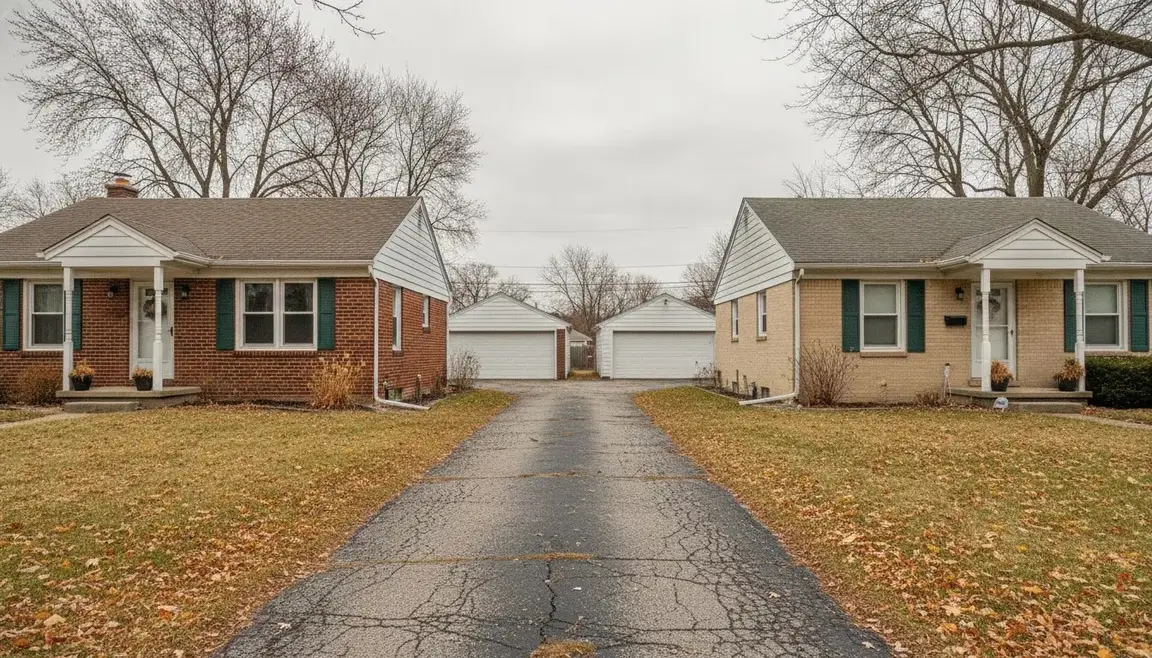

A shared driveway does not stop a Metro Detroit sale, but it does change the homework. Before you list the house or ask for an offer, you need a plain account of who uses the drive, whose land it crosses, and who pays to keep it usable.
Request a cash offer for your Metro Detroit house
When selling a house with a shared driveway, review your deed, any title policy you already have, and any written maintenance agreement. Note which lots use the drive, who handles snow or paving, and whether a dispute is open. On Michigan’s seller disclosure form, shared driveways are a yes, no, or unknown question. An as-is cash offer does not erase those facts.
You may not need to repair or clean the house before an as-is conversation. You still should not guess about access. The sections below cover what the driveway means for a sale and which papers to pull. They also cover the Michigan form, the questions buyers tend to ask, and when a direct cash offer is one option in Oakland, Wayne, or Macomb County.
What selling a house with a shared driveway involves
A shared driveway is the drive that reaches your house and is also used by a neighbor, or that crosses land the neighbor owns. In older Metro Detroit subdivisions it is often a paved strip between two houses. It can also be a gravel lane for two side lots, or a drive that starts on one parcel and ends at the other garage. The layout is ordinary. The sale question is whether you can describe it without guessing.
Before you set a price or invite an offer, sort three facts:
- Whose land is under the pavement? The drive may sit entirely on your lot, entirely on the neighbor’s lot, or straddle the line. Current use does not answer that.
- Who is allowed to use it? Write down which houses use the drive and any limit you already know, such as no overnight parking or no commercial trucks.
- Who pays for upkeep? Snow, gravel, sealcoating, and a full repave are different bills. Note who has actually paid, and whether that matches any paper you have.
If a written driveway or maintenance agreement exists, that paper is the practical record of those three facts. If it does not, say so early. Do not fill the gap from memory or from how the current neighbor happens to behave. A future buyer is buying the arrangement, not the neighbor’s personality.
A shared drive can make some buyers, and some of their lenders, ask more questions. It does not by itself set the price. There is no standard percentage to knock off a Metro Detroit house because the driveway is shared. What moves a buyer’s comfort is whether access and upkeep are documented or still a shrug.
Keep this separate from other sale problems that only look similar. A boundary fight, a private road that serves a whole street, a shared well, or a house with more than one owner on the deed are different questions. This guide stays on the driveway you share with a neighbor.
Documents to gather before you sell
Pull the records before the first showing or the first offer request. You are not expected to become a title examiner. You are expected to know which folder answers which question.
- Find the deed and any title policy from when you bought the house.
- Set aside any written driveway or maintenance agreement, and label whether it was recorded.
- Write one page on who uses the drive, who pays, and whether a dispute is open.
- Draft the seller disclosure from those notes, using unknown where you truly do not know.
- Deed. The current deed is the starting description of the lot. Sometimes it refers to a right of access. Sometimes it is silent. Either result is useful.
- Title paperwork you already have. A prior owner’s title policy or a title commitment from when you bought the house may mention the drive. If you do not have one, do not invent a search. A title company can run a new one when a sale is underway.
- Any written agreement. That includes a recorded maintenance agreement, a private letter both neighbors signed, or even a short snow-plowing note if it is what you have actually followed. Label what is recorded and what is only a private note.
- A draft of the seller disclosure. Start it while you still have time to check a fact, not the night a buyer asks.
A survey helps when you already own one or when you choose to order one because the pavement and the lot line do not obviously match. A shared driveway does not, by itself, mean you must commission a survey before you can sell.
Write the day-to-day facts on one page while they are fresh. Include which lots use the drive, including yours. Note whose land it crosses, if you know. Add who pays for snow, gravel, or paving, and how that split has worked. Mention any parking limit a buyer would feel in the first week. Flag any current dispute, including an unpaid bill or a blocked-access argument.
If no written agreement exists, do not draft one from a form you found online and do not copy a neighbor’s document from another street. If both households want an agreement in place before a buyer appears, a Michigan real estate attorney can write one for those two lots. That is a choice, not a step this article can complete for you.
Out-of-state industry commentary is useful only as a warning about questions, not as Michigan law. A 2020 column from the Greater Harrisburg Association of REALTORS says some lenders ask for a maintenance agreement. Their reason is that an access fight can affect how marketable the house is as loan collateral. A Michigan lender may ask for something similar, or may not. Gather what you have either way.
How Michigan’s seller disclosure asks about driveways
When a Michigan sale uses the statutory seller disclosure form, the driveway question sits in the “Other Items” block, not in the appliance checklist. The form comes from the Seller Disclosure Act, MCL 565.957. The statute describes the statement as a disclosure of condition and information known by the seller. It is not a warranty, and it is not a substitute for inspections a buyer may want. The text of MCL 565.957 on the Michigan Legislature site is the place to read the exact boxes.
The shared-feature question asks if you know of features shared with adjoining landowners. The form lists walls, fences, roads, and driveways, plus other features whose use or maintenance may affect the property. The answers are unknown, yes, or no. If you mark yes, the form asks you to explain. A shared driveway you know about is a yes. Add a short note on who uses it and who maintains it. Do not leave the line blank.
Answer from what you know
The form’s instructions tell the seller to answer every question, report known conditions, complete the form personally, and mark unknown when the facts are not known. Unknown is a real answer. It is not a softer way of saying yes, and it is not a substitute for a fact you do know. If you have plowed the shared drive every winter for a decade and split the gravel bill, “unknown” on maintenance would be hard to defend. If you have never seen a survey and do not know which lot owns the pavement, “unknown” on that narrower point is the honest box.
Use the one-page note from the document step as the explanation, not a legal theory. Name the lots that use the drive, say whether it crosses another lot if you know, say who has paid for snow or repairs, and say whether a dispute is open. Leave easement labels to the title work. The form has a separate question for encroachments, easements, zoning violations, or nonconforming uses, with the same unknown, yes, or no choices. Answer that box from what you know. Do not turn it into a research project on easement types.
The form also states that failing to give a purchaser a signed disclosure statement enables that purchaser to terminate an otherwise binding purchase agreement. Do not assume every Michigan transfer uses this form. Some transfers sit outside the act. Confirm what your sale requires with the title company or a Michigan real estate attorney before you treat the form as optional or as universal.
Other disclosure topics stay in their own articles. Unpermitted work is a different box on the same form, about alterations made without permits, and it is not part of the driveway question.
Questions buyers and lenders tend to ask
Most buyers are not looking for a lecture on land law. They want to know they can reach the garage in January and that a surprise paving bill will not land the month after closing. You can answer those questions with the papers and the one-page note, or you can tell them which point is still unknown.
| Question | Why it matters | What you can have ready |
|---|---|---|
| Who owns the land under the drive? | The buyer needs to know whether access depends on the neighbor’s land. | The deed and, if you have it, the title policy or commitment from your purchase. |
| Who may use it? | The buyer wants the same access you have, including to the garage. | The written agreement, or your note listing each lot that uses the drive. |
| Who pays for maintenance? | Snow, gravel, and paving are the bills neighbors actually fight about. | The agreement if you have one, plus a simple history of who has paid. |
| Is there a current dispute? | An open fight is a different fact from a driveway that simply exists. | A short description and copies of the letters or bills involved. |
| What will the disclosure say? | If the statutory form applies, the shared-driveway box should match your explanation. | The draft answers, including unknown where that is the honest choice. |
Financed buyers add a lender to that list. Some mortgage lenders ask for a recorded maintenance agreement because they are lending against a house they may have to sell later. That concern is the point of the Harrisburg Realtors column, not a Michigan statute, and one lender’s checklist is not the next lender’s checklist. A buyer paying cash may skip the lender list. The buyer still inherits the same driveway.
None of this is the same topic as the costs of a Michigan home sale, which covers commissions, repairs, closing costs, and holding costs on a traditional listing. A shared driveway is not a line item with a statewide dollar figure. Treat it as a documentation question, then price the house from the rest of the facts.
When an as-is cash offer is one option
Some owners would rather not stage the house or host showings. Others would rather not manage a lender’s document list. A direct cash sale is one option in Oakland, Wayne, and Macomb Counties. M1 Home Buyers buys houses directly. It is not a listing brokerage, and it does not represent you as an agent.
The tradeoff is price. Offers are below market value because the buyer is taking the house as it stands, including repairs and the time a retail listing would have required. The number comes from the location, the condition, the work the house needs, and comparable sales. A shared driveway can raise questions during that review. It does not plug into a formula, and nobody honest can promise it will not affect the offer or that it will.
The sequence is an in-person walkthrough, then a cash offer M1 says it can make within 24 to 48 hours. A typical closing runs 7 to 21 days, and a specific file can take longer if title work or a payoff needs it. You do not have to accept. You can take the number, compare it with what a listing would cost you in time and repairs, and walk away.
An as-is sale does not rewrite the deed, cancel a neighbor’s use of the drive, or let you skip facts you know. Bring the same packet you would bring to a listing appointment: the deed, any title policy, any written agreement, and the one-page note on who uses the drive and who pays. If your sale uses the statutory disclosure form, the shared-feature answers still have to match what you know.
When you want that comparison, read how the cash-buying process works before you decide. Questions about the driveway itself, beyond what your papers already say, belong with a Michigan title company or real estate attorney.
Contact M1 Home Buyers about a walkthrough
FAQ: shared driveway questions sellers ask
Can you sell a house with a shared driveway?
Yes. A shared driveway is a fact about access and upkeep, not a ban on selling. Buyers, and a mortgage lender if the buyer needs one, may ask whose land the drive sits on and who maintains it. Have those answers, or say plainly that you do not know, before you list the house or request an offer.
What should you disclose about a shared driveway in Michigan?
The seller’s disclosure form in Michigan’s Seller Disclosure Act asks whether you know of features shared with adjoining owners, and it names driveways. The choices are unknown, yes, or no. If the answer is yes, the form asks you to explain. The statement is what you know. It is not a warranty. Confirm whether your sale uses that form before you rely on it.
Does a shared driveway lower the sale price?
There is no set discount. Some buyers pay less when access or maintenance is unclear, and some do not mind if a written agreement already covers snow, paving, and repairs. What you can control is the paperwork: a deed, any written agreement, and a disclosure that matches the facts. An as-is cash offer is priced from the house, the location, and the work a buyer would still face, not from a driveway formula.
Who pays to maintain a shared driveway?
The deed, a written agreement, or the practice you can actually describe is the answer. Do not assume an even split if the papers say something else. Write down who has paid for snow, gravel, or paving, and note any unpaid dispute, so a buyer is not surprised after closing.
Does an as-is cash sale remove the shared driveway?
No. Selling as-is can skip showings and repair work. It does not rewrite the deed or cancel what you know about the drive. In Oakland, Wayne, and Macomb Counties, M1 Home Buyers can still make a no-obligation cash offer after a walkthrough, and you can decline it.
Talk through a Metro Detroit sale
If the shared driveway is one more reason you would rather not list, M1 Home Buyers can look at the house as it is. The offer is not an obligation, and it will not pretend the driveway is someone else’s problem. Start with a walkthrough request on the contact page.